Madeleine.Cool

Tagged “wikipedia”

  1. Wikipedia has a guide to spotting AI writing

    The whole guide is pretty excellent, but I liked this assessment of the issues of AI content.

    LLMs (and artificial neural networks in general) use statistical algorithms to guess (infer) what should come next based on a large corpus of training material. It thus tends to regress to the mean; that is, the result tends toward the most statistically likely result that applies to the widest variety of cases. It can simultaneously be a strength and a "tell" for detecting AI-generated content.

    For example, LLMs are usually trained on data from the internet in which famous people are generally described with positive, important-sounding language. Consequently, the LLM tends to omit specific, unusual, nuanced facts (which are statistically rare) and replace them with more generic, positive descriptions (which are statistically common). Thus the highly specific "inventor of the first train-coupling device" might become "a revolutionary titan of industry". It is like shouting louder and louder that a portrait shows a uniquely important person, while the portrait itself is fading from a sharp photograph into a blurry, generic sketch. The subject becomes simultaneously less specific and more exaggerated.
    Wikipedia

  2. Revolution, maybe

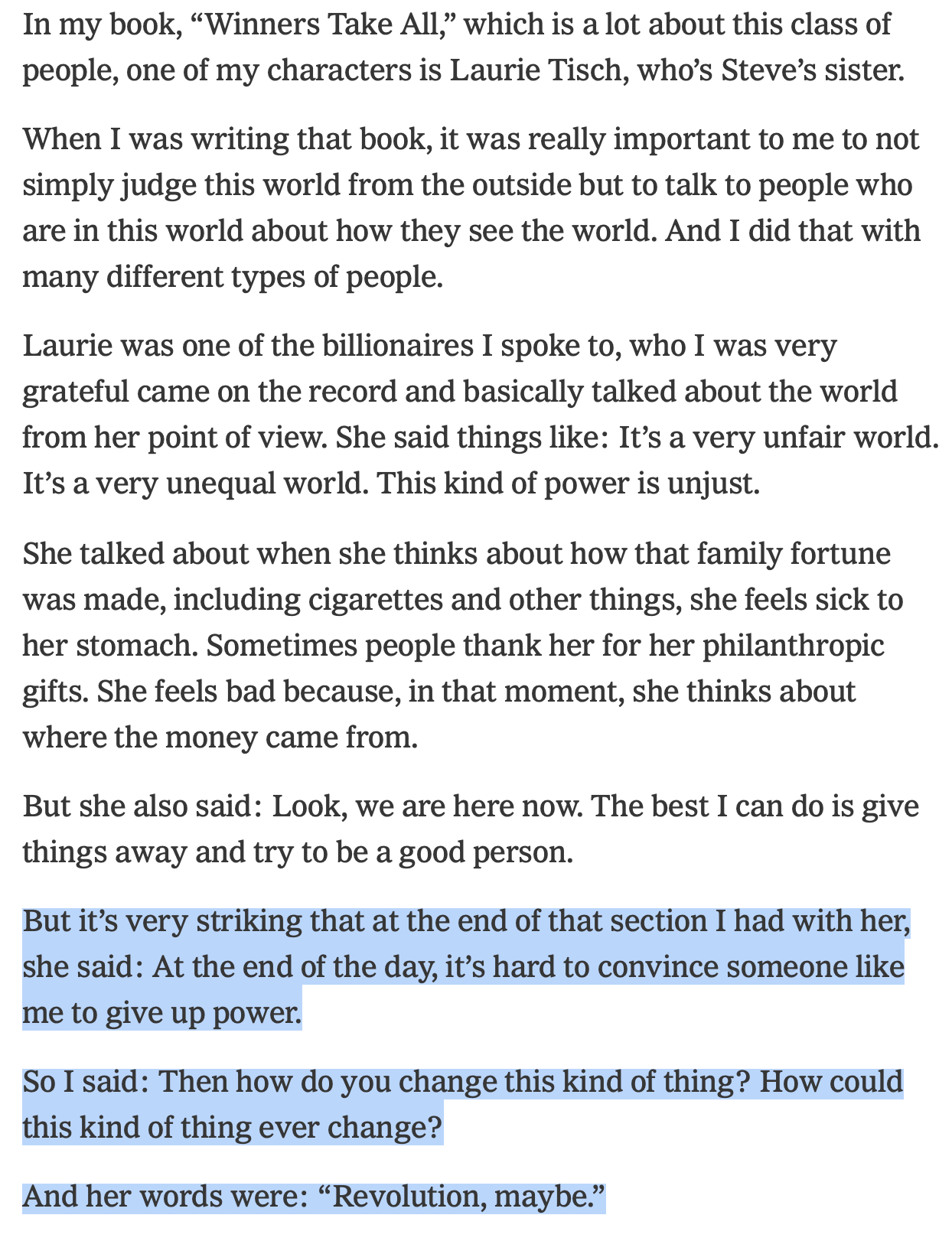
    But it’s very striking that at the end of that section I had with her [Laurie Tisch], she said: At the end of the day, it’s hard to convince someone like me to give up power.

    So I said: Then how do you change this kind of thing? How could this kind of thing ever change?

    And her words were: “Revolution, maybe.”

    Anand Giridharadas on the Ezra Klein Show

  3. The Stakhanovite movement

    The Stakhanovite movement (стаха́новское движе́ние) was a mass cultural movement of workers which originated in the Soviet Union, and encouraged socialist emulation and rationalization of workplace processes. The Stakhanovites (стаха́новцы) modeled themselves after Alexei Stakhanov and took pride in their ability to produce more than was required by working harder and more efficiently, thus contributing to the common good and strengthening the socialist state. The movement began in the coal industry but later spread to many other industries in the Soviet Union. Initially popular, it eventually encountered resistance as the increased productivity led to increased demands on workers.

    Wiktionary

  4. Lily-livered etymology

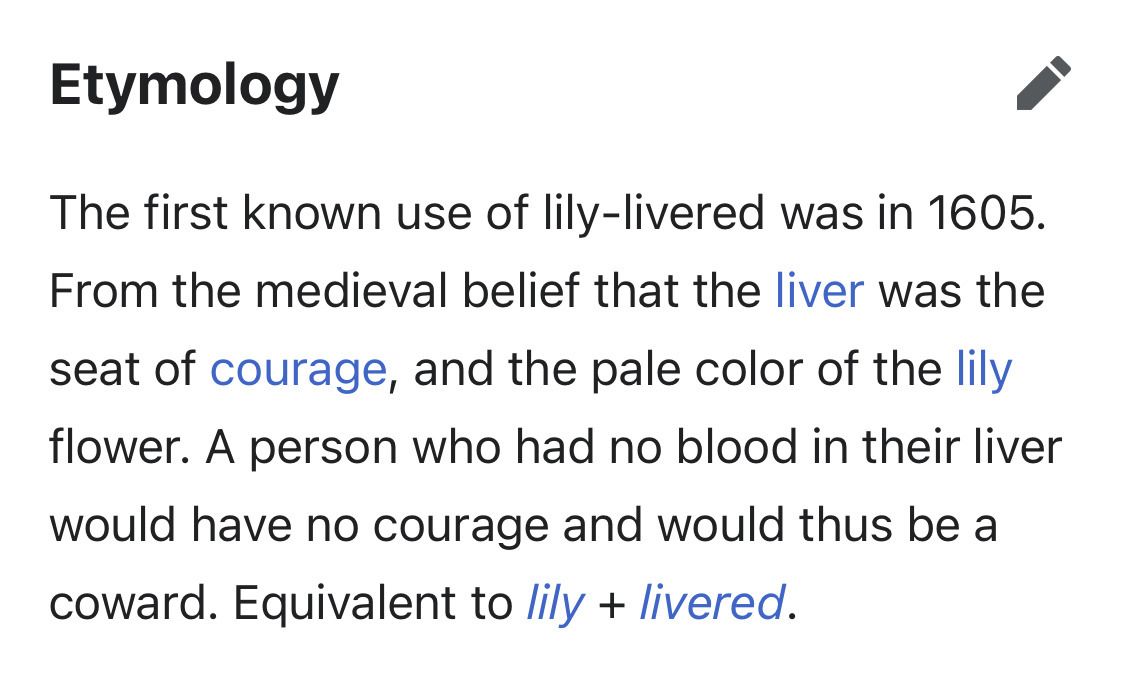
    The first known use of lily-livered was in 1605. From the medieval belief that the liver was the seat of courage, and the pale color of the lily flower. A person who had no blood in their liver would have no courage and would thus be a coward. Equivalent to lily + livered.

    Wiktionary

    lily-livered apparently means cowardly and just comes from the color of lilys being pale and thus not courageous.

See all tags.